Wednesday, December 23, 2020

Expired Warranty

In the last few years when someone asks, “How are you doing?”, I have sometimes answered, “It feels like my warranty expired.” I then continue by noting that once I hit the age of 70 it seemed like a lot of my body parts had reached the end of their useful life and didn’t work as well as they used to.

There is language in the Bible that supports this view. (I’m giving it here in both the King James Version – which I learned growing up – as well as in the NASB.)

“The days of our years are threescore years and ten; and if by reason of strength they be fourscore years, yet is their strength labour and sorrow; for it is soon cut off, and we fly away. … So teach us to number our days, that we may apply our hearts unto wisdom.” (Psalm 90:10,12 KJV)

“As for the days of our life, they contain seventy years, Or if due to strength, eighty years, Yet their pride is only trouble and tragedy; For it quickly passes, and we disappear. … So teach us to number our days, That we may present to You a heart of wisdom.” (Psalm 90:10,12 NASB)

My experience was not quite as dramatic as a friend who, within a few days of his 70th birthday, had a stroke. While beginning to recover from that he came down with shingles. Then to complete the trifecta, he also was diagnosed with COVID-19. What a way to celebrate his entering a new decade of life!

The issues that I’ve been having the last few years are interestingly NOT related to some of the health issues that I had earlier in life.

·       I’ve related here before how I had a uric acid kidney stone in 2001. I take Allopurinol for that to prevent not only a further recurrence but to prevent gout, which is caused by the same excess uric acid.

·       Nor are my issues related to the heart attack I had in 2005. I had two stents inserted at that time, I take a few medications every day, and I see my cardiologist every year, but every test shows that my heart remains healthy.

·       Nor am I showing any mental deterioration due to Alzheimer's to which I am genetically predisposed as my father and his mother both had it. I am participating in a few research studies and all indications are that I am not showing any signs of it.

No, the things I’m dealing with now are in different areas than these.

Sleep – For all of my working career and in the years following it, I generally functioned well on about seven hours of sleep a night. I went to bed around 10-11 and was awake and ready to go between 5-6. When the company I was working for went on flexible scheduling, I would be at work by 7am and finish up by 3:30pm – avoiding any rush hour traffic.

But now I have found that my body requires a minimum of nine hours of sleep. And because my sleep pattern at night is often interrupted, getting enough means a very different sort of schedule. I still go to bed at 10, but my body wakes up at least once in the middle of the night (I’m typing this at 1am). So, I usually only get 8 hours of sleep before 8am. That still leave me an hour short, so I take a nap after lunch. I’ve gotten pretty good at lying down on the sofa, dropping off fairly quickly, then waking in almost exactly an hour. Since I’m no longer working (at least not at a paid job) having this sort of schedule seems to work. But it’s a sign of aging that my body needs more hours of sleep than it used to.

However, the good news is that earlier this year, on the recommendation of my cardiologist, I took a sleep study and now use a CPAP at night. So, while I do sleep more soundly than I did before it has not changed the amount of sleep I need.

Muscle aches – An area that I notice much more frequently is muscle aches. These can appear in a variety of places – arms, shoulders, back, neck, etc. While I had in the past overdone things working in the yard, etc., now it seems that everyday activities can be the cause of these various aches and pains. And whereas before all I needed to do was rest the affected area for a day, now it may take several days to recover.

In my mind, I’m still just as young and strong as I used to be. But the reality is that my body cannot take the punishment that strenuous activity gives it any more. We had a really nice snowfall of about 12” last week. But, as my wife told me, all the bending, lifting, twisting and throwing can no longer be my responsibility. Fortunately, we have a couple of grandsons for whom shoveling is still a fun activity. So, I was able to stay inside and later enjoy the fruits of their labors.

But not every activity is as obvious as shoveling snow. Sometimes even sleeping in the wrong position will give me a “kink” in my neck that will bother me for a day or so. But it’s hard to mentally adapt to the “new normal” and to recognize my weaknesses.

Aching leg joints – Back a few years ago I had a large callus on the ball of my right foot. This was caused by a buildup of bone (essentially arthritis) in that joint. When walking too much caused the callus to tear loose, I had a lot of work done on the tissue of that foot. But during the time that I had it worked on, I had two bouts of sepsis (blood infection). I wrote about the first of those here. That’s now cleared up.

But since the underlying issue is still there, I wear special shoes and have learned to walk in a way that keeps the pressure on the area to a minimum. However, this also changes my gait and puts unusual stress on my leg joints (hips, knees, and right ankle). I’ve noticed recently that my right ankle wants to “roll” on occasion. I haven’t fallen (yet) but it’s an issue that I have to be constantly aware of. And I can also notice that when sleeping (I’m a side sleeper) that my leg joints will get sore if I stay too long in one position.

So, if you see me walking with what appears to be a limp, it’s all due to the problem on the ball of my foot. If needed, I can straighten up and walk “normally”, but when I do I’m putting more pressure on that part of the foot and so I usually avoid doing so. My podiatrist does not recommend surgery as that may aggravate a lot of other things, so I’ve just got to keep dealing with it. Just another part of the aging process.


A wise person once said, “Getting old is not for sissies.” And to that I’ll just add, “My warranty has expired.”

Sunday, December 13, 2020

Christmas 2020


It’s been exactly one year since I wrote our last Christmas letter, so I’m right on schedule once again. But that’s not as a result of planning on my part, it’s just that this is a weekend day and I have a little free time for a change.

Family

Despite the impact of the COVID-19 virus, we were able to do some of our typical extended family activities. This year, instead of having one of our FL grandchildren come up here to spend a month, we went the other way and took Ethan down to FL to spend time there. On 6/22, the day after Father’s Day, he and I flew to FL – his first flight ever. (He enjoyed everything about the flight except when the plane banked to line up with the runway for landing.) I stayed until the end of the week so I could have some time with all of them, then flew back on Friday. Ethan stayed until 7/17. Then the entire FL crew flew up here so we could all spend our normal week together at Pinebrook. This was the first one in a few years that Chris could join us as he had been in the middle east with the Army in 2018 and at the Boy Scout Jamboree in 2019. We all had a good time together.

Chris gives us a video call almost every week so we can talk to him and see the rest of the family on a regular basis. We really appreciate having this sort of involvement.

Unless things get much worse in the next few weeks with COVID restrictions, all of us here in PA will be flying down to FL for the week after Christmas. Pam’s parents gifted us with their accumulated points from the time-share they have used for many years as they have decided to give it up. So Kim, Matthew, and the boys will stay there while Donna and I stay with Chris and Pam (about ½ hour away unless it’s rush hour then much longer). And we’ll all get to enjoy the amenities of the resort (heated pool!). All of us are looking forward to it – especially as the three younger boys and Matthew have never flown before.

Schooling Changes

Back in January, I had a difficult decision to make. The Board of Elders at our church was losing several members (two had sons who had recently committed suicide and they took an extended leave from the board, one was retiring, one was moving to Germany to become a houseparent at a missionary school). I had gone on extended leave six years ago to give a chance for some of the younger members to develop their leadership abilities, but decided that I needed to reactivate and help fill in the holes being left by so many stepping down at once. But the Elders met the same day as the Board of Trustees for the Charter School that our grandsons were attending and I couldn’t attend both. So, I reluctantly resigned from the Board of Trustees.

I had been the biggest supporter of the school administration and within two weeks of when I resigned, some of the other board members – who wanted to have a bigger say in how the school was run – fired the CEO/Principal and the business manager. Kim then felt that she was being discriminated against as a parent who felt as I did. Since the school only goes through 5th grade, we were going to have to make a decision shortly anyway about where to send the boys, and this became one of the factors to consider.

Shortly after making this decision, COVID hit! So, for the remainder of the school year the boys were all at home getting some level of virtual learning, but all ungraded. Kim was then working from home since her workplace closed down for in-person work, and she was fine with that as she would no longer have to commute 80 minutes each way. But with her shut up in her bedroom with a computer, that meant that Donna and I had primary responsibility for the boys’ schooling.

Over the summer, Kim made the decision to move the boys from the charter school to a small Christian school nearby. So they started the school year wearing uniforms, going to school five days a week (which none of the local public schools were doing), and using the packet system. That meant that Donna and I were free during the day. I won’t go into a lot of details, but by the middle of October, we realized it wasn’t working out and so another change was in order. After some checking around, the boys were disenrolled from there and were enrolled in Liberty University Online Academy (LUOA). While LUOA provides all the curriculum, and all the course work is completed online, the state of PA does not recognize any online schools except ones located in PA and so from their perspective the boys are being homeschooled. Donna and I are now back to supervising their learning and we spend most of our days across the street!

Donna works nearly full-time with Asher since he is in 1st grade and still a beginning reader. I work mostly with Caleb and Isaiah who are both in 3rd grade (one of the advantages of this latest change is that LUOA was willing to give Caleb a readiness test and admit him to 3rd grade, so he has skipped a year). I also assist Ethan in 5th grade, but he is much more independent in getting things done. Kim helps out by assisting with things like science projects which can be done in the evenings. It’s definitely a time commitment, and we’ve had to drop a lot of other things that we had hoped to get done this year.

To get the boys a bit more socialization, we also put them in our church’s after-school program – 4 days a week from 2:15-5:00 – the church offers that to students primarily from the two schools just a block or two from the church. But that has also now ended for the time being due to the schools moving to all virtual learning because of COVID. These are challenging times!

Health Updates

While we’ve all managed to stay relatively healthy as we have kept quite isolated because of COVID, there have been an assortment of challenges due to our getting older. I had my second Shingles vaccine and had every single side effect listed. It was a rough 36 hours. As I write this, Donna had her Shingles shots this year as well – the first was uneventful, but she’s having a few side effects from the second one.

On the recommendation of my cardiologist, I had a sleep study (done at home due to COVID) and am now using a CPAP machine – which has eliminated any remaining sleep apnea. A side effect is that since I am using a connection that only uses my nostrils, I have a chin strap that keeps my mouth from falling open at night as I was formerly a mouth breather. But in so doing, it has improved my oral health as well (I used to take nightly tablets to stop my mouth from drying out which impacted my gums).

I also now have mostly implants instead of natural teeth – a full set on the top and all the molars on the bottom. This has been a multi-year process, removing bad teeth as needed and replacing them – but I now have the best smile and tooth alignment that I’ve ever had and my dentist (who we’ve had for 40 years) is very pleased.

I’m also continuing my involvement in a couple of Alzheimer’s studies – and I’m happy to report that I haven’t lost all my marbles yet! When I do the 3-times-a-year analysis for the one study it continues to show no decline in mental ability. So I’m no more crazy than I ever was :D.

Miscellaneous

This Christmas letter will be entry 495 in my blog – it seems crazy that I’ve written that many. But in checking, I’ve written 53 in the past 12 months, just about once a week. The largest number are historical or genealogical in nature, some are reminiscing about my growing up, and some are about current events. So if you want to understand me – just read my blog.

Meanwhile, Donna and I are looking forward to celebrating our 50th anniversary this coming year. It doesn’t seem possible that five decades have gone by. Our major gift will be a gazebo (placed in the front yard of Kim’s house as we will eventually make that our home as well with a garage conversion). For many years we bought a glass bell on our anniversary – so fittingly, this gazebo has a bell-shaped roof. We’ve already purchased it from a local dealer but we’ll be preparing a place for it and take delivery in the spring.

So as you prepare to celebrate the holidays, and perhaps you feel a little different this year because of the impact of the pandemic, remember that God is ALWAYS in control. We don’t know what’s going to happen next – to the world or to ourselves – but He does. And if we acknowledge Him and accept the sacrifice that was made with His son, Jesus Christ, then we can have the assurance that He has promised.

We love you all!

Alan & Donna


[Start of Schooling – wearing school uniforms]


[Online schooling]


[Thanksgiving – yumm!]


Friday, December 11, 2020

Wolcott History – Census Records, Schools, and Teachers

Wolcott Census

There is an excellent plot of the census totals for Wolcott in (*1) which I have copied below. As you can see, the population was less than 1000 individuals from the time of the first US census in 1800 until after 1930. After the construction and paving of what is now Route 69 in 1934, the population increased sharply and with the end of WWII in 1945, that increase accelerated for the next 25 years. The increase since then has been much more gradual. But within the period from 1800 to 1930, you can also see a drop from the close to 1000 population to only half that before it recovered in the early part of the 1900s.

[Wolcott Census Chart]


To get a better look at the census figures, here they are in a chart format. The first three columns mirror those in Wikipedia (*2), but as I began looking at them, I had to actually update Wikipedia as there were some missing or misplaced figures, so I used other sources to get the correct results (*2a-*2c).

In the census records from before 1850, there is only one line for each family, with the head of household recorded followed by a breakdown of the household by gender and age-range. Thus, while we can count the number of families in town, there is not much detailed analysis that can be done. I have gone through all the census reports for Wolcott from 1800 to 1940 counting all the families and put the results in the next two columns. (Note that the 1890 census details were lost in a fire so no analysis of that year can be done). It is interesting to note the change in the size of families in town over the decades.

[Wolcott Census Details]


Wolcott Schools

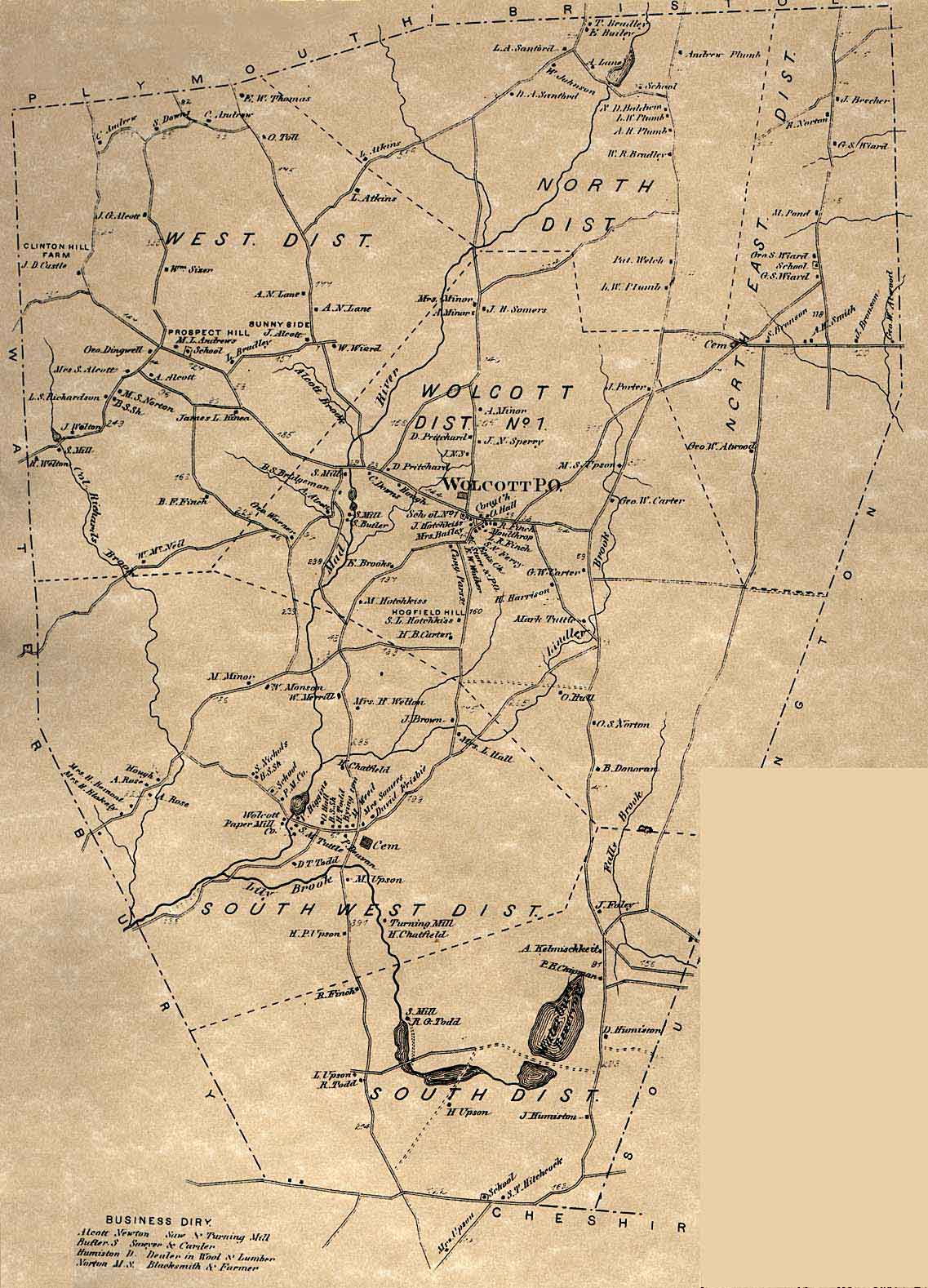
In 2008, Flo Goodman, in one of her excellent monthly articles about Wolcott History, gave a brief synopsis of the history of the Wolcott school system (*3). I’ve commented before on this as well (*4). As she noted, “During the 1770 meeting of the Ecclesiastical Society, a school committee was chosen and it was voted to divide the town into districts. Nine districts were established as follows: North, Northeast, Center, Southwest, South, West, Mill Place, East, and Southeast. … [O]nce school houses were built, the Southeast district and the one at Mill Place were discontinued.” In the map attached to (*3), which is from 1868, you can see these districts outlined. (Note that by 1868, the East district is also no longer in existence. The East and Southeast districts formerly occupied the area between Woodtick/County roads and the eastern border of town which were vacant by the time this map was produced as the land had been leased to New Britain and Southington for use as a watershed for their reservoirs which were built a few years later.)

In an earlier blog about the 1870 census and this map (*5), I made some comments about these school districts as well as mentioning the three teachers who were listed in that census. But unresolved was why there were only three teachers in the census when there were still clearly six schools in six school districts. The synopsis that Flo wrote (*3) clearly shows a continuity of schooling for several of these schools (Southwest pre-1821-1950, North until 1945, South pre 1812-1966, Center 1856-1930, West thru 1946). I have not been able to locate enough teachers in the census records for the 1860-1930 period to staff each of these schools, so the question about staffing is still unresolved. However, I’d like to report on what I have found.

Teachers

As noted above, the census records prior to 1850 only list the head of house, so we will not be able to do any analysis for those years. While the 1850 lists all members of the house and gives their age and gender, the only one with a listed occupation is the head of the house. Thus, we cannot identify any teachers in this census either (they are likely to be either daughters in the 17-25 age range, or female borders in that same range). So, our analysis of the census records will begin in 1860.

I have pulled out the names of anyone with a listed occupation of “teacher” or “school teacher”, then tried to find out more about them.

1860

Mary Alcott, 18, daughter of James Alcott (West district)

Born in 1842 in Wolcott, married Coral Dwight Blakeslee in 1868 and continued living in Wolcott, died in 1917 and is buried in Bristol

Antoinette Alcott, 20, daughter of George Alcott (West district)

Born in 1840 in Wolcott to George Alcott and Harriett (Hattie) [Nichols], married in 1863 to Oliver Smith, died in 1919 and is buried in Chicopee, MA

Anna Alcott, 17, daughter of George Alcott (West district)

Born in 1843 in Wolcott to George Alcott and Harriett (Hattie) [Nichols], married in 1865 to Edward Peck, died in 1897 and buried in Derby

Since all three Alcott girls lived in the West district, it is unknown which school they taught in.

1870

Anna E Root, 17, boarding with George Atwood family (Northeast district)

Born in 1853 in Plainville to Timothy Root and Lucelia (Celia) [Merrill], family moved to Wolcott sometime around 1869, married in 1874 to Ransom B Hall, widowed in 1889, married a second time in 1902 to widower Wilson Pierpont (my great-grandfather), died in 1938 and buried in Wolcott (Woodtick cemetery)

Ella Crandal, 22, boarding with Lowry Richardson family (West district)

Born in 1848 to Philander Crandall and Lucinda [Richardson], married in 1880 to William Palmer, died in 1930 and buried in Colchester, CT. Is she boarding with her uncle and aunt?

Sarah L Fiske, 25, daughter of Pastor Warren C Fiske (Center district)

Born in 1845 to Warren Fiske and Harriet [Parsons], died in 1934 and buried in Southington

1880

Fanny Tracy, 24, boarding with Charles Hall family

No other information available

Harriet Stevens, 26, boarding with Ransom B Hall family

No other information available. Note that she was living with someone, Anna [Root] Hall, who had been a teacher like herself 10 years previously

Harriet Fairclough, 17, daughter of Joseph Fairclough

Born in 1864 to Joseph and Catherine Fairclough, married in 1890 to Charles Grant, died in 1951 and buried in Bristol

Lillie Frisbie, 18, boarding with Frank Munson family

Born in 1859(?) to Merritt Frisbie and Fidelia [Chatfield], married in 1886 to Frederick Upson Higgins, died in 1920 and buried in Southington

1900

Nellie A Brown/Browne, 30, daughter of John P Brown (immigrant)

Born in Wolcott in 1870 to John Brown (immigrant from Ireland) and Sarah Ann Pratt (from Cheshire), never married, died in 1955 and buried in Waterbury

Grace R Butler, 20, boarding with Andrew J Slater family

Born in Seymour in 1880 to Samuel Butler and Ella [Rankin], married in 1907 to Herbert Arthur, died in 1928 and buried in Seymour

Minnie (Alfreda Minnie) Norton, 36, sister of Carroll Norton

Born in 1863 in Wolcott to Rufus Norton and Ellen [Beecher], never married, died in 1956

1910

Mabel Upson, 32, granddaughter of Esther Lane

Born in 1877 in Wolcott to Evelyn Upson and Elsie [Lane], married to Arthur Harrison, died in 1949 and buried in Wolcott (Edgewood cemetery)

Nellie A Brown, 39, daughter of Sarah Brown

Not married, still teaching 10 years later

1920

Ruth I Todd, 29, daughter of John R S Todd

Born in 1890 in Wolcott to John Robert Streat Todd and Edith [Williams], in 1930 was still teaching but in New Haven, never married, died in 1978 and buried in Wolcott (Woodtick cemetery)

Dora M Merrick, 60, boarding with William E Tyrrell

Born in 1859 in MA, never married, died in 1933 and buried in Wilbraham, MA

Marjorie E Warner, 25, daughter of Wilfred Warner

Born in 1894 in Waterbury to Wilfred Warner and Julia [Ashton], married Norris Wildman, died in 1949 and buried in New Milford, CT

Nellie A Brown, 49, daughter of Sarah Brown

Not married, still teaching 20 years later!

1930

Celinda Wakelee, 24, daughter of John B Wakelee

Born in 1906 in Wolcott to John Wakelee and Rose [Andrews], married in 1940 to Elliott Mayo, died in 1997 and buried in Wolcott (Woodtick cemetery)

Margaret Shay, 19, boarding with Claude V Badger family

No other information available

1940

Celinda Wakelee, 34, daughter of Rose Wakelee

Not yet married (wedding was a month after school ended), still teaching

Sarah Quinn, 25, daughter of Thomas Quinn

Born in 1915 to Thomas Quinn and Bertha [French], unmarried, died in 2001


Notes:

*1 - http://connecticuthistory.org/over-time-wolcotts-historical-population/

*2 - https://en.wikipedia.org/wiki/Wolcott,_Connecticut (note that I made a Wikipedia correction to bring these figures into line with the official ones on the CT state site in *2a-*2c)

*2a - https://portal.ct.gov/SOTS/Register-Manual/Section-VII/Population-1756-1820

*2b - https://portal.ct.gov/SOTS/Register-Manual/Section-VII/Population-1830---1890

*2c - https://portal.ct.gov/SOTS/Register-Manual/Section-VII/Population-1900-1960

*3 - https://web.tapr.org/~wa1lou/whs/oldnews200808.html

*4 - https://ramblinrussells.blogspot.com/2015/04/wolcott-history-chronology-of-wolcott.html

*5 - https://ramblinrussells.blogspot.com/2020/12/wolcott-history-learnings-from-1870.html


Tuesday, December 1, 2020

Wolcott History – Learnings from the 1870 Census

In my writings about Wolcott history over the years, I’ve mentioned the 1870 Federal Census a couple of times. In (*1), I noted that 1870 was the low point in the population of the town. My words there were:

From its high in 1810 (952), the population of the town began a slow decline, eventually bottoming out at fewer than 500 (491) in 1870. It did not reach 1000 in population again until 1930.

And in (*2), I was exploring the roots of my grandfather’s step-mother, Anna [Root] [Hall] Pierpont, who was a school teacher in Wolcott in 1870. I’ll touch on this more below.

But because of the availability of a map of the town that is posted on the wolcotthistory.org website (*3), we have a unique opportunity to look at the geography of the census. And we can use this to explore a couple of questions that some others have had about the town’s history at the time. I’ll bring those up as appropriate below.

[1868 Map]


How the Census Was Taken

Unlike today’s Federal Census, where every household receives a form in the mail that can be filled out and either mailed or submitted online, the census in times past was done by a census taker visiting each home in-person, interviewing the head of household or their spouse, and filling in the appropriate line on the census form. The person who was the census taker for Wolcott in 1870 was a man named Sturgis Judd. He was 61 and lived in Waterbury with his wife and 25yo daughter who was a milliner. His primary occupation was that of “Collector of Bills”, but for two months in the summer of 1870 he worked full-time taking the census. Beginning on June 1st, he and one other man took the census for the entire city of Waterbury. Sturgis did 2/3 of the homes (about 10,000 residents in over 1300 dwellings). He finished this task in mid-July, signed the last page (he had completed 227 pages of the 333 that it took to record everyone in Waterbury), then immediately moved on to taking the Wolcott census.

Having done 1300 dwellings in 6 weeks, and with only 120 dwellings in Wolcott, he may have thought that Wolcott would only take a few days, but since all the roads in Wolcott were unpaved and the houses often far apart, it took him most of a week to finish tabulating the 491 names in the Wolcott census.

Sturgis was very thorough in his work, noting for each person their name, age, gender, race, occupation, and all the other information required. A few interesting statistics from my analysis:

·       490 were “W”hite, there was only one “M”ulatto (colored) farm laborer

·       Nearly all occupations were “farmer,” “keeping house,”, “at home” (young children), “at school,” or “farm laborer”. Some of the other “occupations” were domestic servant (4), clergyman (1), school teacher (3) (more on this below), tanner (2), and about 10 or so miscellaneous occupations.

Working the way around the town

Because of the availability of the map from just two years earlier, it was easy to match the family names from the census with the names associated with each home and plot the path that Sturgis took around town. Note in the below that I am using the names of current day Wolcott roads, I am not sure what the names were back then.

He began in the SW corner of the town on what is now Meriden Road, the first home being that of Sheldon Hitchcock. He then went up Todd Road as far as Central Ave, then across Central Ave to East Street, and up East Street/County Road. This covered all seven families in the South School District. Here is the first part of page one of the census as an example.

[First part of page 1 of 1870 census]


Continuing up County Road, then Woodtick Road as far as Catering Road, he visited 9 families in the Central School District. He then went in Beecher Road, going down the road that led to where the New Britain reservoir is today, then back and up the rest of Beecher Road as far as the Norton Farm. This covered all 9 families in the North East School District. Here, Sturgis ran out of time on that Thursday, 7/14. I’m not sure whether he went back to Waterbury for the night or found a family to stay with for the night. At any rate, he would have had to back track all the way down Beecher Road to Woodtick Road as Long Swamp Road did not yet exist.

Starting off on Friday, 7/15, Sturgis began back north on Woodtick Road, then continuing north on Route 69. Then he went in North Street to Spindle Hill Road, going slightly north on that road as far as the Bristol line, then back south. All 17 families here would be in the North School District. Continuing on Spindle Hill Road, Andrews Road and other side roads, and ending up on Lyman Road, he visited all 22 families in the West School District before once again running out of daylight.

On Saturday, 7/16, Sturgis began by continuing on Potuccos Ring Road to Route 69 as far as Center Street, then up to the center of town and visiting families there and on Bound Line Road, visiting a total of 23 families in the Center School District. He ended up at the home of the pastor of the Congregational Church, Warren Finch. There was no census taking on Sunday.

On Monday, 7/18 Sturgis began by going down Brooks Hill Road (the first family being the Brooks family after whom the road is named), covering the last 3 families in the Center School District and then making his way down toward Woodtick Road visiting 10 families in the South West School District.

Finally, on Tuesday, 7/19, Sturgis finished the remaining homes in the Woodtick/Todd Road area, then went down Woodtick Road back to Waterbury, visiting the last 20 homes in the South West School District.

It was a long five days, plus a day of rest on Sunday, of going to every home in Wolcott! But the record of all his visits is preserved in Sturgis’ excellent handwriting for us to see 150 years later.

Schools in Wolcott

I was asked recently if I thought that the entire network of one-room schools that had originally been established continued through the decline in population. Although the 1868 map shows six school buildings, were they all used, or were schools combined?

Before answering that question, a few words about schools in the mid-1800s are in order.

While compulsory education was not legislated in Connecticut until 1872, most people were already going to school in 1870. Local schools were often one-room schools which only served the elementary years (grades 1-8) with high schools only available in larger cities and students going on to “higher” education boarding nearby. Teachers were required to be unmarried and were nearly all female. They were generally in their late-teens or early-20s (the only requirement being that they had already finished elementary school). If they did not live nearby (often the case), then they boarded with a local family.

Such was the situation in Wolcott. All the students noted as being “at school” were between age 7 and 14/15 (remember that school began in grade 1, there was no kindergarten, and ended after grade 8). There were 91 such students among the 491 residents and there were three teachers in the census. The distribution of students among the six school districts noted on the 1868 map was as follows: N-14, NE-8, W-19, C-24, SW-20, S-6.

There were three teachers in the census. In the North East District was Anna Root, age 17, who was boarding with the family of George Atwood (who had one child of school age). As I had noted in (*2), Anna’s home was in the Woodtick area of town, but she travelled north to the Atwood home at the beginning of each week and then returned home on Friday after school – it being too far to make the daily commute to the North East school.

In the West District was Ella Crandal, age 22. She was from Hartford, and she was boarding with the Richardson family about 5 houses away from the West District school. In the Center District was Sarah Finch, age 25. She was the daughter of the town clergyman and lived right across the green from the Center School. But what about the other three schools?

I suspect the North District school was served by a teacher who lived in Bristol as it was so close to that much larger town. But with 14 students, it was certainly large enough to continue. Similarly, the South District school was served by a teacher from Waterbury as it was right on Meriden Road which was the border of Waterbury.

For the large South West District school, there are two possibilities. One is that the teacher lived in Waterbury and commuted up Woodtick Road each day. I recall seeing information about individuals who made that commute in the past. But the other possibility is related to the timing of the census.

When Sturgis Judd began taking the census, it was Thursday, July 14. When visiting the home of George Atwood, Anna Root was noted as living there – it being a school day when she would have been boarding. But by the time he visited the Root family home in the Woodtick area in the late afternoon of Monday, July 18, Anna was there instead and had the distinction of being counted twice in the same census. I suspect that Friday, July 15, was the last day of the school term, so that by the following Monday, Anna was back home as July 18 was no longer a school day. Since she was back home, then the teacher who had been boarding in the Woodtick area would have also finished for the term and she similarly would not have been counted in the census as she would have returned home (possibly to Waterbury). So, whether the South West teacher was commuting from elsewhere, or whether she was no longer boarding in the area due to the timing of the census, we have a logical explanation of why she was not counted in the 1870 census. In the latter case, Anna Root being counted twice just made up for the South West teacher being missed in the census.

The Two-Home Problem

If you study the 1868 map closely, you will note that there are three instances where there are two dots listed with the same name. Two of the instances are on Spindle Hill Road in the West School District – the two occurrences of Albert N. Lane, and the two occurrences of Levi Atkins (one in the West District and one just over the border in the North District). The other occurrence is in the North East District where George W. Atwood appears twice – once on the E-W road near the eastern edge of town, and once on the N-S road that goes down toward where the Southington Reservoir is currently located.

Most farms of this era, and Wolcott was nearly all a farming community, would have had a building complex – the main farm house where the family lived, one or more barns that held animals, hay, or other farm equipment, and possibly other smaller outbuilding for storage purposes as well. In any case there would have been only a single small dot on the map needed to identify the location of this complex of buildings and the owner of that complex.

But what about a situation where a large farm has additional fields located away from the main complex? If there were additional buildings associated with these additional fields, how would one know when driving past them who they belonged to? I believe that is the case here. Note that for both Albert Lane and Levi Atkins, that the second dot on the map is not only down the road a bit, but that it is on the opposite side of the road. In order for anyone using the map to know who to contact regarding that isolated building, they can see the presence of another building farther up the road with the same owner.

The situation with George Atwood is a little more complicated. We can be pretty certain that George and his family lived in the home at the eastern boundary of the town. That’s because when Sturgis Judd was visiting each home taking the census, he went to the homes of Stillman Bronson and Anson Smith before going to the homes farther down the road – George Atwood and Jarvis Bronson. Then he went to the George Wiand home up on Beecher Road near the North East School next. This visit order is pretty good confirmation of which dot on the map represents the home where the Atwood family lived (and which is close enough to the school that it would have been a logical place for Anna Root to board during the week).

[George Atwood map]


The N-S road heading down toward the current Southington Reservoir was already abandoned by 1868. Although there had been several homes there in the late 1700s, the farms had all been abandoned and no one lived there anymore. It remains an abandoned road to this day, although it is still open to hiking and the CT Blue Trails uses a portion of the northern part of it. But in 1868 there was still one active building on the west side of the road – apparently a barn that was owned by George Atwood who was trying to farm one of the still existent fields that he had purchased along with the ones around his house. It’s possible that this barn is what my cousin Rob saw on a recent hike as all that remains is a 20’ wide foundation right alongside the road.

Conclusion

The availability of this old map that is only two years removed from the 1870 census of Wolcott has made this analysis all possible. I’m grateful for the Wolcott Historical Society for preserving these artifacts from the town’s past, as well as for the current technology that makes things like scanned images of century-old census records available via the Internet. Doing historical research from the comfort of one’s home is so much easier than having to visit a library that might have such things on microfilm.

Notes:

*1 - https://ramblinrussells.blogspot.com/2015/04/wolcott-history-chronology-of-wolcott.html

*2 - https://ramblinrussells.blogspot.com/2017/12/genealogy-story-tangled-wolcott-web.html

*3 - https://web.tapr.org/~wa1lou/whs/1868mapA.jpg


Tuesday, November 24, 2020

Deep Connecticut Roots

The settlement of colonial Connecticut began in earnest is the mid-1630s with groups traveling from the Massachusetts Bay Colony either overland to the Connecticut River Valley and places like Wethersfield and Hartford, or via ship along the coast to places like New Haven and Milford. In each of these groups there were a number who were my ancestors. While the migration from England known as the Great Migration ended somewhat abruptly in 1640 with the outbreak of the civil war there, the spreading of the colonists to other new cities and towns, both along the Connecticut River and along Long Island Sound continued.

I had always thought of my ancestors being from New Haven as my mother’s maiden name was Pierpont and the Pierpont family is centered there due to Rev. James Pierpont who became the pastor of the Congregational Church in the late 1600s. Although he was from Boston and received his education at Harvard, he was very well connected and through marriages of his and his descendants established lineages with many other Connecticut families. My father’s family was originally from Dutchess County, NY, but they had also married into a number of CT families.

So, when there was a recent Facebook posting about the founders of Hartford and I decided to see which of them were in my family tree, I was somewhat surprised to discover that about a quarter of them are my ancestors (*1). I was able to do this because I spent several weeks last year tracing back all my family lines to the original immigrant families so I could simply do name searches for each of the Hartford founders to see if they were in my tree. I still have quite a few roadblocks and a number of relationships that I don’t totally trust, but I’m pretty sure of most of my research (*2).

Recently, there are been a number of postings in another Facebook forum about ancestors from other Connecticut cities/towns and I’ve been wondering if I would have similar success there. There is a list in (*3) that shows the founding date of each city/town in the state, so I have undertaken a quest to go through the early cities. I’ve used the first 20 years of founding dates, i.e. 1633-1653 as the cutoff as there are 14 on that list and then a gap until later settlements.

Below are the overall results as well as the details for the other 13 cities/town in alphabetical order. I am astounded at how deep and broad my Connecticut genealogical roots are!

A few notes on the below. First, the number of founders of each place is sometimes subject to interpretation. For some there are multiple sources which quote different figures. I have not tried to reconcile these disparate figures, but have used the references that seem to have the most inclusive list of individuals. Second, there are sometimes different spellings for a person’s name. This is fairly common in colonial times and especially vowel substitution makes genealogical research challenging. Third, I’ve used the following notations in the detail list: (a) g9gf means great*9 grandfather; (b) I’ve marked with an “*” those who are ancestors of my wife who has some family lines back to CT, some of these are to the same individuals as my ancestors, some are in addition; and (c) the notation “(step)” refers to a few cases where a woman had multiple marriages, usually due to the death of a first husband, and while she is my direct ancestor, the individual listed as a founder is not the father of the child that led to me.

[Chart]


Notes:

*1 – https://ramblinrussells.blogspot.com/2020/11/founders-of-hartford.html

*2 – https://ramblinrussells.blogspot.com/2019/04/great-migration-ancestors.html

*3 – https://ctstatelibrary.org/cttowns/counties


Deep River (formerly Saybrook)

https://saybrookhistory.org/history-of-old-saybrook/

·       Lion Gardiner - *


Fairfield

https://www.ancestry.com/imageviewer/collections/16157/images/dvm_LocHist004103-00047-1?ssrc=&backlabel=Return

·       William Bateman – g9gf

·       James Bennett – g9gf

·       William Frost – g10gf

·       Henry Gray – g9gf

·       George Squire – g9gf

·       Thomas Staples – g10gf*

·       Benjamin Turney – g10gf

·       Ephraim Wheeler – g9gf

·       Thomas Wheeler – g10gf


Farmington

http://josfamilyhistory.com/locations/farmington-ct.htm#:~:text=Most%20of%20Farmington's%20first%20settlers,the%20new%20colony%2C%20such%20as

·       John Bronson – g8gf

·       William Hickox – g9gf

·       Thomas Orton – (step)g9gf

·       Thomas Upson – g8gf*

·       George Wyllys - *


Guilford

https://www.geni.com/projects/Original-Planters-Guilford-Connecticut-1639/1494

·       John Bishop – g11gf

·       Francis Bushnell – g11gf

·       William Dudley – g10gf

·       John Parmarly/Parmalee – g8gf


Middletown

http://www.middletown1650.org/Membership.html

·       John Hall – g9gf

·       Giles Hamlin – g8gf

·       George Hubbard – g10gf*

·       William Smith - *

·       Nathaniel White – g8gf


Milford

http://daneovideo.com/mhs-new/founders.php

·       Nathaniel Baldwin – g9gf

·       Timothy Baldwin – g9gf

·       Henry Botsford – g9gf

·       Nathaniel Briscoe – g9gf

·       John Burwell – (step)g9gf

·       Nicholas Camp – g10gf

·       George Clark – g9gf

·       Jasper Gunn – g10gf

·       John Lane – g9gf

·       Richard Miles – (step)g8gf

·       James Prudden – g11gf

·       Peter Prudden – g9gf

·       Micah Tomkins/Tompkins – g9gf

·       Thomas Wheeler – g10gf

·       Thomas Uffott/Ufford – g9gf


New Haven

https://www.geni.com/projects/Founders-of-the-New-Haven-Colony/30351

·       William Andrews – g10gf*

·       John Charles – g10gf

·       John Clark – g10gf

·       John Cooper – g9gf*

·       Jasper Crane – g10gf

·       Timothy Ford – g8gf

·       Matthew Gilbert – g9gf*

·       Matthias Hitchcock – *

·       William Ives – (step)g8gf

·       Andrew Messenger – g9gf

·       John Peacock – g10gf

·       William Potter – g8gf*

·       William Preston – g10gf

·       Robert Seeley – g10gf

·       George Smith – g9gf

·       Nathaniel Turner – g10gf

·       William Tuttle – g9gf

·       Thomas Yale – g9gf


New London

http://dunhamwilcox.net/town_hist/nl-chap11a.htm

·       George Chappell - *

·       Robert Isbell – g9gf

·       Thomas Stedman – g9gf


Norwalk

https://en.wikipedia.org/wiki/Category:Founding_settlers_of_Norwalk,_Connecticut

https://familypedia.wikia.org/wiki/Norwalk_1649_Founders_Stone

·       George Abbitt/Abbott – g9gf

·       Thomas Fitch – g9gf

·       John Gregory – g9gf

·       Ralph Keeler – g9gf

·       Daniel Kellogg – g8gf*

·       Thomas Lupton – g8gf

·       Matthew Marvin Sr – g11gf

·       John Ruscoe – g9gf


Stamford

https://www.ctgenweb.org/county/cofairfield/pages/stamford/settlers_page.htm

·       Francis Bell - *

·       Jeffrey Ferris - *

·       Joseph Garnsey – (step)g11gf

·       John Holly – g10gf

·       Francis Holmes – g11gf

·       Simon Hoyt – g9gf

·       Nicholas Knapp - *

·       Robert Lockwood – g8gf

·       Obadiah Seeley – g10gf

·       Henry Smith - *

·       John Waterbury – g11gf

·       Jonas Weed – g10gf*


Stratford

https://www.geni.com/projects/Founding-Families-of-Stratford-Connecticut/47320

·       Adam Blackman – g10gf

·       Richard Boothe – g10gf

·       John Curtis – g8gf*

·       Thomas Fairchild – g10gf

·       Henry Gregory – g10gf

·       Francis Hall – g9gf

·       Richard Harvey – g10gf

·       John Hurd – g9gf

·       Joseph Judson – g9gf

·       John Peacock – g10gf

·       Thomas Sherwood – g10gf

·       John Tompson/Thompson – g10gf

·       Thomas Ufford – g9gf

·       John Wells/Welles – g9gf*

·       William WIlcockson/WIlcockson – g10gf


Wethersfield

https://sites.google.com/a/oldconnecticutpath.com/oldconnecticutpath/home/5-founders-of-wethersfield

·       Robert Seeley – g10gf

·       Nathaniel Foote – g8gf


Windsor

http://tourwindsorct.org/historic/FoundersofWindsorM/

https://sites.google.com/a/oldconnecticutpath.com/oldconnecticutpath/home/4-founders-of-windsor

https://www.werelate.org/wiki/List_of_Founders_of_Windsor,_Connecticut

·       Matthew Allyn – g11gf

·       John Bartlett – *

·       William Buell – g10gf

·       Nicholas Denslow – g11gf

·       Thomas Dibble – g9gf

·       John Drake – *

·       John Hawkes – *

·       William Hulbert – *

·       Joseph Loomis – g10gf*

·       Thomas Newberry – g11gf

·       Thomas Newell – g9gf

·       Nicholas Palmer – g10gf

·       Thomas Parsons – g9gf

·       William Phelps – g10gf

·       Eltweed Pomeroy – (step)g9gf

·       Samuel Pond – g9gf

·       John Porter – g10gf

·       John Taylor – g10gf

·       Richard Vore – g10gf